Automated Segmentation of Developing Motor Neurons in Fluorescence Microscopy
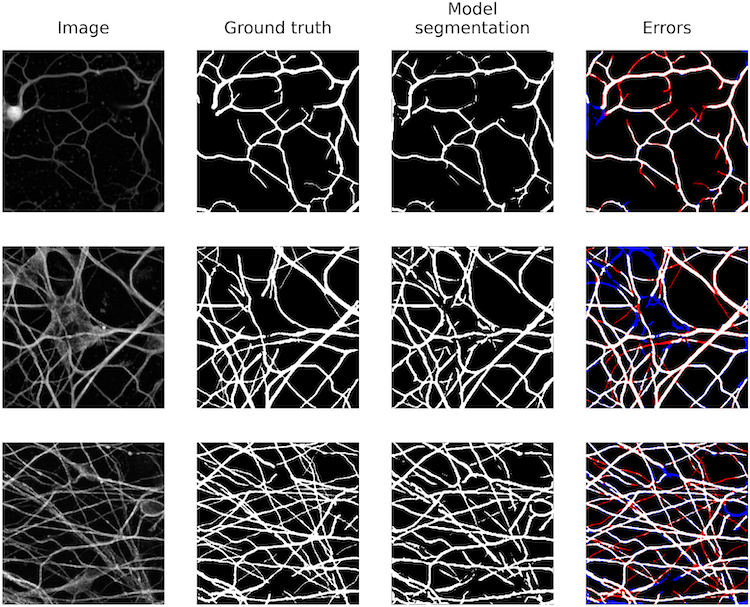
The shape of a cell is a phenotypic marker closely tied to its physiological state, and in amyotrophic lateral sclerosis, a fatal disease marked by the loss of motor neurons, subtle morphological changes in the neurites carry information about disease status. Studying those changes means segmenting motor neurons across large volumes of high-content fluorescence microscopy, far more than can be traced by hand, which raised the question of how to automate that segmentation reliably.
Digital tracing of neuronal morphology is a long-standing and still difficult problem: the most popular tools remain semi-automatic and do not scale, while fully supervised deep networks demand large amounts of labelled training data whose manual creation is the real bottleneck. The hypothesis was that a two-step strategy could sidestep that cost, first segmenting with a classical image-processing pipeline, then training a convolutional network on the masks that pipeline produces, so that the network generalises beyond its imperfect teacher without any hand-drawn ground truth.
Both pipelines were built and evaluated on the high-content microscopy dataset. The classical pipeline supplied the automatic labels, and the fully convolutional network trained on them did not merely reproduce its teacher: it learned to correct a substantial share of the first pipeline’s errors, which is the outcome the strategy depends on, since a network that only imitated its imperfect labels would have no reason to exist. Both methods outperformed the segmentation tools commonly applied to this kind of imagery, with the network ahead of the classical pipeline that trained it.
The hypothesis is confirmed: a network bootstrapped from a classical pipeline both removes the manual-labelling barrier and improves on the labels it was given, so the annotation bottleneck is not the hard constraint it appears to be. The answer to the opening question is accordingly that motor-neuron segmentation can be automated at the volumes this research requires, without hand-drawn ground truth, provided a classical pipeline good enough to teach from can be constructed first. The result is a practical basis for the quantitative, morphology-based study of motor neurons in ALS research.