Evaluating Cross-Domain Adaptation Strategies for Foundation Models: A Study on Fluorescein Angiography
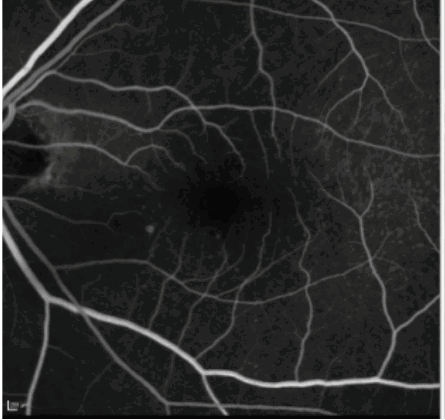
Fluorescein angiography is a workhorse retinal modality for visualising vascular leakage and inflammation, but labelled angiography data is scarce because its interpretation demands expert time, unlike the abundantly annotated colour fundus photography that dominates ophthalmic datasets. Large pre-trained “foundation” models promise to carry knowledge from data-rich modalities into data-poor ones, which raised the question the thesis examined: can the representations captured by retinal foundation models trained on colour fundus photography be adapted efficiently to fluorescein angiography tasks?
Vision Transformers pre-trained at scale had shown strong results on colour fundus photography, with RETFound trained on roughly a million such images and its lighter RETFound Green variant on around seventy-five thousand, while parameter-efficient tuning and self-supervised continual pre-training had cut adaptation costs in other settings. What remained unclear was whether a fundus-photography prior actually helps on angiography over a generic natural-image prior. Three hypotheses were put to the test: that a related-domain retinal prior beats an ImageNet prior on angiography, that low-rank adaptation matches full fine-tuning at a fraction of the trainable parameters, and that self-supervised continual pre-training on angiography improves cross-domain transfer.
Four backbones were compared, RETFound against its ViT-Large ImageNet baseline and RETFound Green against its ViT-Small baseline, across eleven classification tasks on two angiography datasets: the public 3rd APTOS competition set of 1,877 unique eyes and a private Jules-Gonin set of 752 eyes covering four uveitis-related inflammatory signs. Each backbone was adapted by full fine-tuning, by low-rank adaptation, and by self-supervised continual pre-training with a Masked Autoencoder or Token Reconstruction, and scored with AU-ROC, F1 and AU-IMCP. Outcomes depended on scale: RETFound underperformed its ViT-Large baseline, whereas RETFound Green outperformed its ViT-Small baseline and ranked best overall. Low-rank adaptation updated only one to four percent of parameters while costing the large model just 0.93 percent against full fine-tuning, though smaller models proved more sensitive to it. A Masked Autoencoder step on unlabelled angiography lifted RETFound by 8.29 percent, while Token Reconstruction reduced RETFound Green by 6.78 percent.
The three hypotheses fare differently, which is the substance of the answer. The first is refuted as stated: a fundus-photography prior does not universally beat a natural-image one, and specialising a model to the source modality can actively cost performance on the target. The second holds, with a caveat about scale — low-rank adaptation is close to free on the large backbone and a reasonable default under data scarcity, but smaller models tolerate it less well. The third is conditional rather than true or false: continued self-supervised pre-training on unlabelled angiography helps or harms depending on the objective chosen, not on whether it is applied. Taken together these say that what transfers is not domain proximity but the kind of representation a pre-training objective leaves behind. The main limits are using only the final frame of each sequence, which shrank the effective sample to the 1,877 and 752 eyes above, and a heuristic rather than exhaustive hyperparameter search. The work informs the group’s continuing uveitis collaboration with Jules-Gonin by identifying which adaptation strategies are worth pursuing on scarce angiography data, and its central finding was published at ISBI 2026.