Measuring Bias in AI Anatomical Structure Segmentation Models
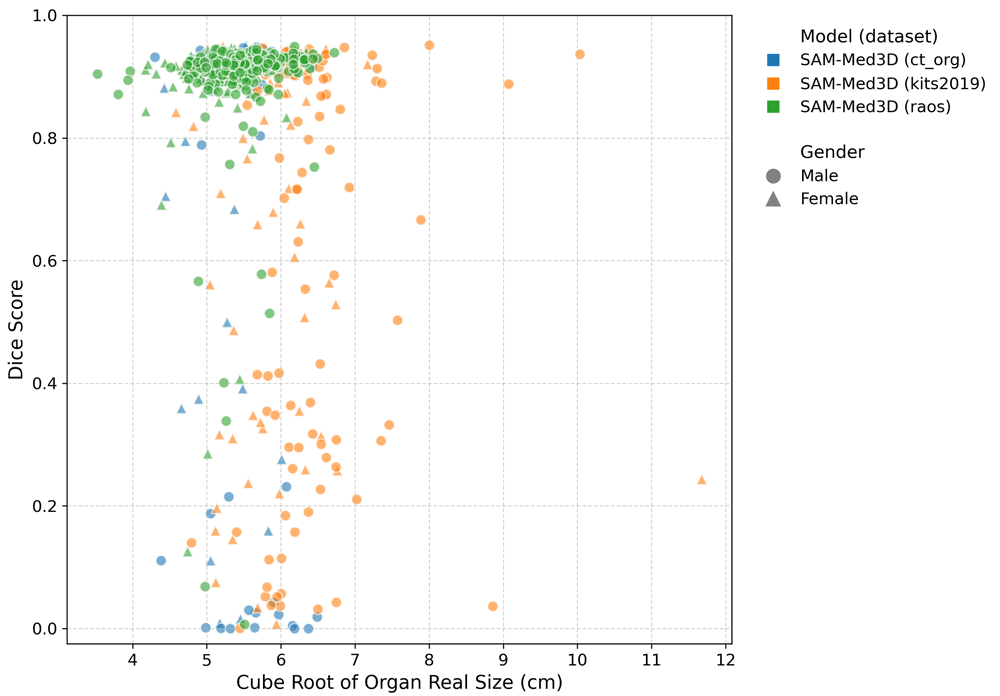
AI segmentation models are increasingly woven into medical-imaging workflows, where they outline anatomical structures automatically. A model that is accurate on average, however, can still be less accurate for some patients than for others. Because evaluation usually reports only overall segmentation quality, this thesis asked whether widely used pretrained models are biased across patient subgroups and organ characteristics.
The leading foundational segmentation models — TotalSegmentator, SAM-Med3D and Vista3D — are trained on large medical-imaging collections and tuned to maximise overall performance across many anatomies, while comparatively little attention has gone to fairness, and what fairness work exists has concentrated on classification rather than segmentation. The hypothesis was that these models carry measurable biases tied both to patient gender and to the size of the organ being segmented, and further that the two are entangled, organ size acting as a confounder for any apparent gender effect.
The three pretrained models were evaluated on the liver, both kidneys and the urinary bladder across three public collections, CT-ORG, AbdomenCT-1K and KiTS19, with quality read through the Dice similarity coefficient, the Hausdorff distance and the relative volume difference. Statistically significant gender disparities appeared in 24 to 33 percent of all organ-and-metric combinations, and organ size mattered more still: grouping organs into small, medium and large produced significant differences in 52 to 70 percent of combinations. The confounding was demonstrated rather than assumed, showing that part of what presents as a gender effect is the downstream consequence of systematically different organ volumes.
Both parts of the hypothesis are confirmed, and the answer to the opening question is that yes, widely deployed segmentation models are measurably biased — across every model examined, not merely the weakest. The practical consequence is that an aggregate Dice score conceals precisely the disparities a clinic would care about, so trustworthy medical AI requires subgroup-aware evaluation as a matter of routine. The thesis leaves behind an empirical template for conducting it, including the reminder that subgroup differences must be tested against anatomical confounders before being attributed to demographics.