Stability and Accuracy of Radiomic Features in Medical Image Classification
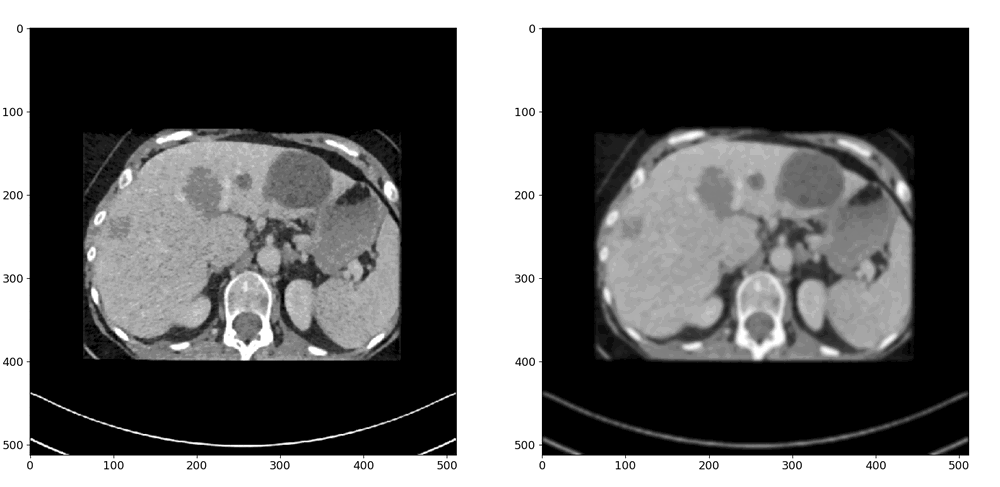
Radiomics turns a medical image into a set of quantitative biomarkers, but the promise fails quietly when those numbers shift as soon as the acquisition protocol changes. Many traditional radiomic features are exactly that unstable, which undermines reproducibility and makes results hard to move between sites. The thesis set out to find features that are at once stable across acquisitions and genuinely discriminative.
Two families of features were put forward as candidates to enrich the radiomic toolbox: Gabor features and deep features from pre-trained networks. The hypothesis was that these could match or beat traditional hand-crafted features on the two properties that matter together, stability under changing scanner settings and discriminative power on real disease.
Stability was quantified on anthropomorphic phantom CT acquired under varied scanner settings, where the same physical object is imaged repeatedly so that any change in a feature’s value can only come from the acquisition; discriminative power was measured separately as the area under the curve of models trained on real patient data. The result splits cleanly. The single highest-ranked features were traditional ones, so the hypothesis fails at its strongest reading. Yet a substantial number of Gabor and deep features possessed better combined radiomic qualities than most traditional features, and the decisive test — models applied to the external phantom data, standing in for an unseen scanner — put the deep-feature models ahead of every alternative.
The hypothesis is thus confirmed in the sense that matters. Learned features do not win every individual comparison, but they hold their value when the acquisition changes, which is the condition under which a biomarker has to survive to be clinically useful at all. The answer to the opening question is that features stable and discriminative do exist, and that they are more often learned than hand-designed. Beyond the ranking itself, the thesis leaves a principled, phantom-based procedure for weighing stability against discriminative power, so that future studies can choose features on evidence rather than on convention.