Trustworthy Biometric Verification under Spoofing Attacks: Application to the Face Mode
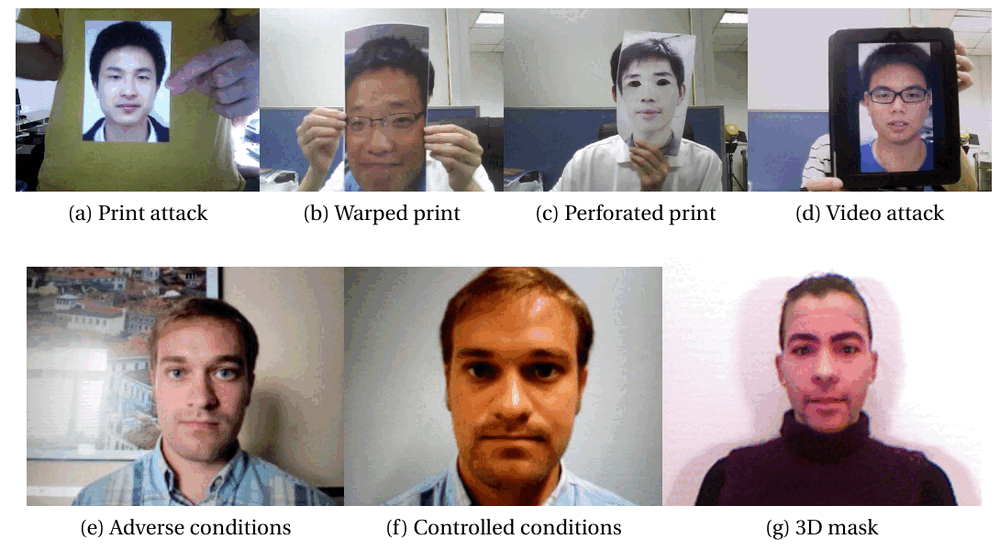
Biometric verification promises to recognise a person by who they are rather than by what they remember, and face recognition is among its most convenient forms. That convenience comes with a weakness: a system can be fooled by a presentation attack, a printed photograph or a replayed video of the legitimate user. As face verification spread into everyday devices, this thesis asked how such systems can be made trustworthy in the presence of spoofing, and how that trustworthiness can even be measured.
At the time, presentation-attack detection was a young and fragmented field, with countermeasures evaluated on private data and no agreed way to report how vulnerable a verification system really was. The thesis took the position that resistance to spoofing must be treated as a first-class property of verification, addressed both by designing effective face countermeasures and by building an evaluation methodology that quantifies a system’s behaviour when it is actually attacked.
The integration was pursued at three distinct points. At the input, the identity the verification system already knows was made available to the detector, producing client-specific countermeasures in both generative and discriminative form that outperformed their client-independent equivalents and, more importantly, held up better against attacks unseen during training. At the output, the two systems’ scores were fused as a multiple-expert problem, with several fusion rules compared on verification accuracy and robustness together. At the evaluation stage, the thesis proposed the Expected Performance and Spoofability framework, which treats the system as facing three kinds of input — genuine clients, zero-effort impostors and deliberate attacks — and its accompanying curve, which allows two systems to be compared without the bias that follows from tuning on the test set. All of it was released as free software alongside the public Replay-Attack database and a family of texture and motion countermeasures.
The hypothesis is borne out at every one of the three points, and the answer to the opening question is that trustworthiness is not a property of the detector at all but of the pair. A countermeasure evaluated alone can look strong and still leave the system it protects vulnerable, because the relevant error rates only exist once attacks are admitted as a third class of input. The database, the software and the metrics became widely used reference points in presentation-attack detection, and the framing — evaluate the protected system, not the protection — is the thesis’s most durable contribution to how the community reports biometric trustworthiness.