Towards Scalable Foundation Models for Sleep EEG and Polysomnography
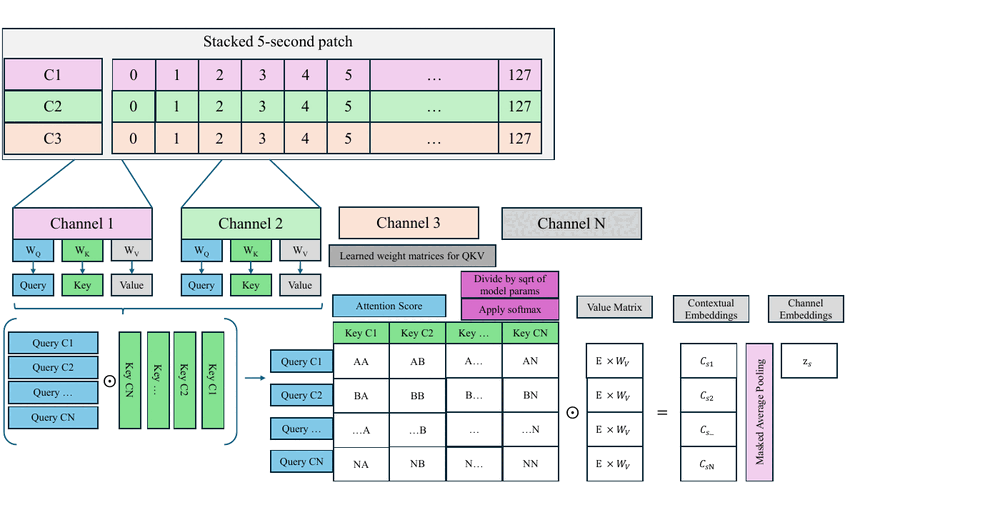
Diagnosing sleep disorders relies on polysomnography, the all-night recording of brain, heart, breathing, and movement signals. Machine-learning models for this data are usually trained one task at a time and for one sensor montage, which does not scale to the variety of clinics and questions in sleep medicine. Foundation models, large encoders pretrained once and reused across many tasks, have reshaped vision and language, which raised the question this thesis pursued: can scalable foundation models be built for sleep EEG and polysomnography that transfer across tasks and montages?
Most earlier sleep models were both task-specific and montage-specific, while self-supervised pretraining was only beginning to reach the field. The hypothesis was that a single large encoder, pretrained without labels on diverse polysomnography, could learn representations general enough that new tasks need only a lightweight head rather than a model trained from scratch.
A multimodal set-then-sequence Transformer encoder was pretrained contrastively on about 13,000 subjects drawn from ten public cohorts, then frozen while lightweight sequence heads were trained on a held-out Sleep Heart Health Study cohort for two downstream tasks, sleep staging and sleep-apnoea detection. Pretraining scale, losses for class imbalance, downstream modality sets and contrastive objectives were each varied systematically. The frozen encoder reached 76.2 percent balanced accuracy for sleep staging from brain-activity channels alone while remaining competitive at apnoea detection, and the channel analysis produced the sharpest result: respiratory signals are indispensable for apnoea yet contribute little to staging, so the two tasks make genuinely different demands on the sensor set.
The hypothesis is supported with one important qualification. A single frozen encoder does serve several tasks through lightweight heads, which answers the opening question affirmatively — but how much it helps depends less on the pretraining recipe than on which modalities the downstream clinic actually records, so a foundation model does not free a deployment from thinking about its montage. The work leaves a concrete, reusable encoder and a systematic account of which design choices carry weight, and is the step on which later theses in the group build.