Trustworthy and Fair Medical AI
Making medical AI fair across patient subgroups and useful in the clinic, with evaluation frameworks, foundation-model bias analysis, and utility-fairness trade-offs.
Partnerships

A medical model can be accurate on average and still let specific groups of patients down, which is exactly the failure a clinic cannot afford. This line of work cuts across our medical projects and tries to make fairness something we can measure and act on, rather than hope for, and to understand honestly how it trades off against clinical usefulness now that large foundation models are everywhere.
Major achievements
Fairness only becomes actionable once it can be measured and traded off honestly. Fairness
criteria conflict with one another — improving parity on one attribute routinely degrades it on
another, and no single score captures the outcome — so we built a model-agnostic evaluation
framework that treats utility and each fairness criterion as separate objectives in one
multi-objective problem, summarising how competing systems compare through a compact
radar-chart view backed by measures of convergence, capacity and diversity. It was validated on
simulations and on three real-world medical-imaging datasets, and is released as the
open-source fairical package. We paired it with an optimisation method that constrains loss
minimisation with several fairness metrics simultaneously, so that fairness across multiple
protected attributes at once is imposed deliberately rather than left to chance, and which
holds up on the imbalanced, modestly sized datasets where such methods usually falter. A
companion review argued that keeping medical imaging equitable as foundation models arrive
demands systematic intervention across the whole pipeline — data documentation, curation,
deployment protocols and policy — rather than the model-level fix the literature had favoured.
Looking inside the foundation models themselves produced results worth stating plainly. Fine-tuning a retinal foundation model on a Brazilian cohort quite unlike its pre-training population, we found that self-supervised pre-training does narrow performance gaps across gender and age compared with supervised training, but that the label efficiency which makes these models attractive cuts the other way: the less data the model is fine-tuned on, the wider the demographic gap becomes. On the constructive side, we showed that a foundation model’s own backbone can substitute for demographic labels a hospital does not hold, by clustering its embeddings into groups that stand in for protected attributes; used for both mitigation and evaluation, this narrowed the gender gap by 4.4% in distribution and 6.2% out of it, though age proved stubborn and remains open. None of this stays abstract: these evaluation and mitigation methods feed straight back into our radiology and ophthalmology work, where consistent performance across subgroups is a clinical requirement rather than a nicety.
Key publications
- Loss-Conditioned Utility-Fairness Boundary Modeling for Medical Imaging. Fairness of AI in Medical Imaging (FAIMI), MICCAI 2026 Workshops, 2026. Conference Paper · Homepage · PDF
- Fair Foundation Models for Medical Image Analysis: Challenges and Perspectives. ACM Transactions on Computing for Healthcare, 2026. Journal Article · doi:10.1145/3793542
- A Multi-Objective Evaluation Framework for Analyzing Utility-Fairness Trade-Offs in Machine Learning Systems. The Journal of Machine Learning for Biomedical Imaging, 2025. Journal Article · doi:10.59275/j.melba.2025-ab9a
- Optimizing Fairness and Utility in Healthcare Machine Learning Models. Applied Soft Computing, 2025. Journal Article · doi:10.1016/j.asoc.2025.113426
- Using Backbone Foundation Model for Evaluating Fairness in Chest Radiography Without Demographic Data. Ethics and Fairness in Medical Imaging, 2024. Conference Paper · doi:10.1007/978-3-031-72787-0_11
- Does Data-Efficient Generalization Exacerbate Bias in Foundation Models?. Fairness and Ethics Towards Transparent AI: Facing the Challenge through Model Debiasing (FAILED), ECCV 2024 Workshops, 2024. Conference Paper · doi:10.48550/arxiv.2408.16154 · PDF
Software
- fairical. A Python library for evaluating and tuning machine-learning systems via multi-objective optimisation, balancing fairness metrics against utility; it approximates Pareto fronts of utility–fairness trade-offs with convergence, diversity, and hypervolume scores. Software GPL-3.0 · Docs · PyPI · conda-forge · Source
- credible. scikit-learn-compatible implementations of machine-learning metrics augmented with credible/confidence intervals, so performance measurements come with quantified uncertainty bounds. Software GPL-3.0 · Docs · PyPI · conda-forge · Source
Supervised theses
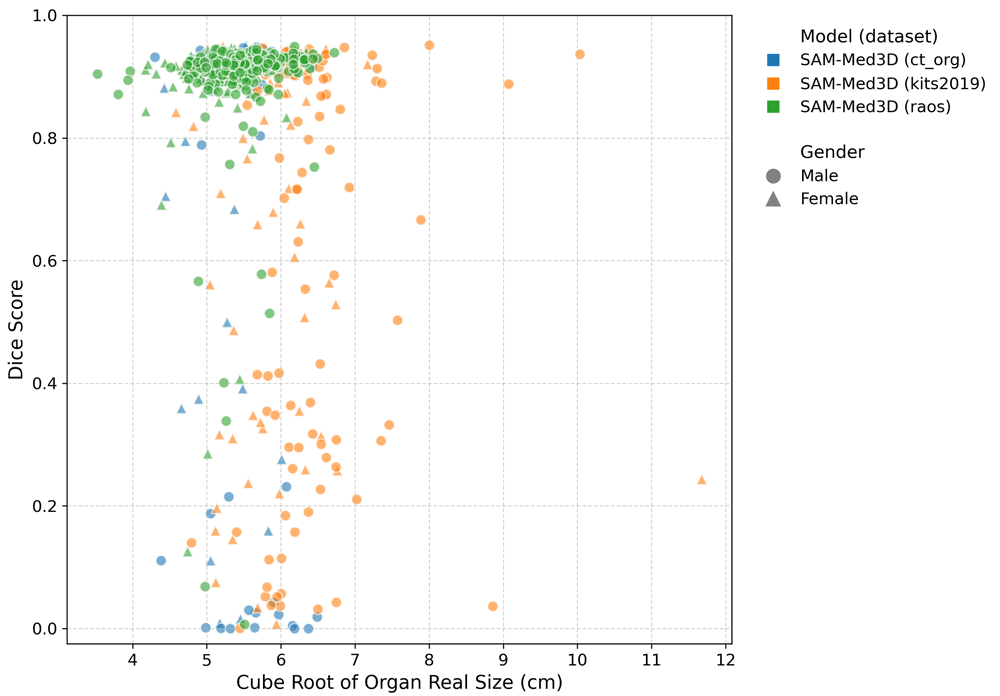
Measuring Bias in AI Anatomical Structure Segmentation Models
AI models that outline organs in medical scans can quietly work better for some patients than others. This thesis measured gender and organ-size bias in three widely used segmentation models.