Reproducible Research and Open Science
Software suites and open platforms that make computational research repeatable, shareable, extensible, and stable, including the BEAT open-science platform.

All of my work runs on a fully reproducible framework, and I care about this more than almost anything else in how we do research. Too many computational studies ship with vague method descriptions, unavailable data, and undocumented code, which makes them impossible to reproduce. A workflow that genuinely works has to be repeatable, shareable, extensible, and stable. It helps to remember that the person who most often has to reproduce your analysis is your future self.
Major achievements
It began with tooling. Bob, first described in 2012, gave researchers a Python environment
backed by fast C++ in which an experiment carries its own dataset protocols, so that “the same
data” means the same partitions rather than the same download. That design now runs through the
suites we build and maintain — mednet for medical images and signals, sleepless for
polysomnography, credible and fairical for evaluation — across tasks as different as medical
image analysis, biometrics, presentation-attack detection and remote photoplethysmography, all
released under free licences with documentation and packages rather than as a repository dump.
The harder obstacle was data that genuinely cannot be shared, which no amount of open code
fixes. For that we built the BEAT platform, a web-based open computing environment where
experiments are submitted, run and compared against data the experimenter never sees, closing
the gap between “the software is available” and “the result can be checked”.
Reproducibility is not only about code; it is also about what a number means. A supervised
master’s thesis took up evaluation methodology itself, deriving credible regions for the common
performance measures from their posterior distributions so that a reported improvement can be
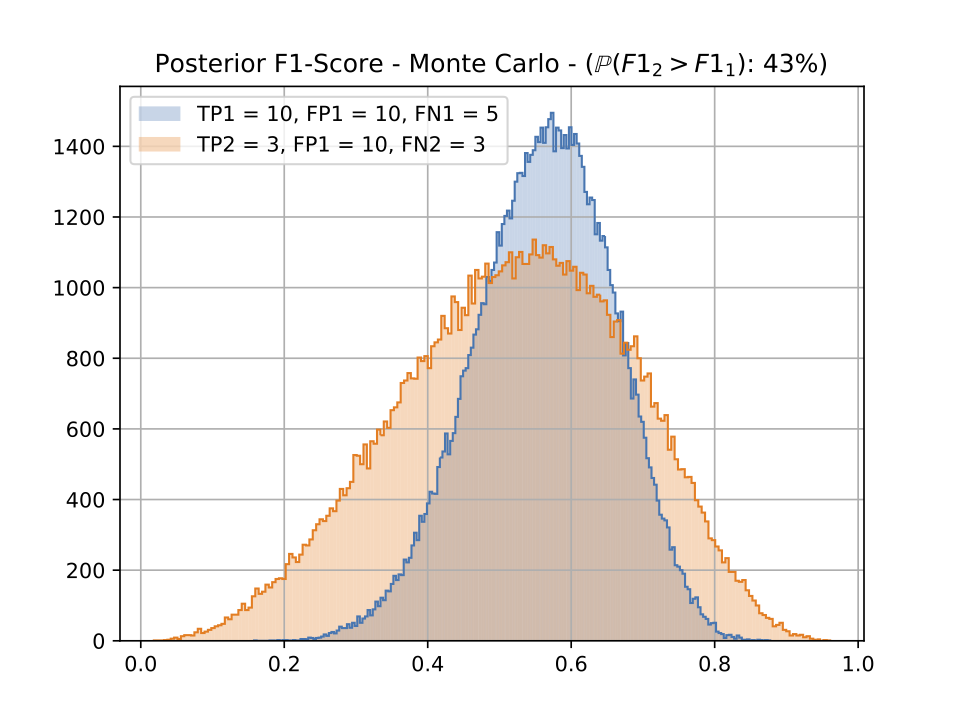
told apart from noise on the small datasets typical of medical work. One worked example makes
the case better than any argument: two systems scoring 0.571 and 0.315 by the usual F1 formula
look decisively different, yet under the probabilistic treatment the apparently weaker system
actually outperforms the other in 43% of simulated draws. That work became the open-source
credible package, and fairical later carried the same instinct into fairness, where a
single score is even less trustworthy because the criteria genuinely conflict and must be
reported as a trade-off rather than collapsed into one number. The habit shows up across the
group’s work — the papers that release the code behind their figures, the studies that exist
mainly to establish an honest protocol, the benchmarks deliberately built to be unflattering.
Beyond our own projects I stay active in reviewing the reproducibility of published research and
in lowering the barrier for others to contribute reproducibly, on the conviction that a result
no one can rerun is not yet a result.
Key publications
- When Specialization Helps (and Hurts): Cross-Modality Transfer in Ophthalmic Imaging with Foundation Models. 2026 IEEE 23rd International Symposium on Biomedical Imaging, 2026. Conference Paper · doi:10.1109/isbi61048.2026.11515636 · Homepage · Software
- Refining Tuberculosis Detection in CXR Imaging: Addressing Bias in Deep Neural Networks via Interpretability. 2024 12th European Workshop on Visual Information Processing (EUVIP), 2024. Conference Paper · doi:10.1109/euvip61797.2024.10772829 · Homepage · PDF · Software
Software
- fairical. A Python library for evaluating and tuning machine-learning systems via multi-objective optimisation, balancing fairness metrics against utility; it approximates Pareto fronts of utility–fairness trade-offs with convergence, diversity, and hypervolume scores. Software GPL-3.0 · Docs · PyPI · conda-forge · Source
- mednet. A framework for developing and analysing deep neural network architectures for medical data (2D/3D images and signals), with ready access to many public medical-imaging datasets and extensible model architectures. Software GPL-3.0 · Docs · PyPI · conda-forge · Source
- credible. scikit-learn-compatible implementations of machine-learning metrics augmented with credible/confidence intervals, so performance measurements come with quantified uncertainty bounds. Software GPL-3.0 · Docs · PyPI · conda-forge · Source
- sleepless. A benchmarking package for evaluating machine- and deep-learning techniques on polysomnography biosignals for sleep-stage classification, covering feature extraction, training, prediction, and evaluation across datasets and algorithms. Software GPL-3.0 · Docs · PyPI · Source
- BEAT. A web-based open-science platform for running, sharing, and reusing reproducible machine-learning experiments with secure access to data and code, even when the underlying data cannot be published. Software AGPL-3.0 archived · Docs · Source
- Bob. A free signal-processing and machine-learning toolbox developed at Idiap: a comprehensive, Python-first framework to build, experiment with, and reproduce pattern-recognition and machine-learning workflows. Software BSD-3-Clause archived · Docs · PyPI · conda-forge · Source
Supervised theses
Is System A Statistically Better Than System B?
On a small test set, is model A really better than model B, or did it just get lucky? This thesis expresses common performance measures as probability distributions so that comparisons come with honest uncertainty.